One Verification, Three Teams: Choosing IDV for Compliance, Fraud, and Growth


Access this Resource
Author

RESOURCE Info
Mentioned in this article
Why compliance, fraud, and growth teams should set identity verification requirements together, before the evaluation, not after.
Most identity verification (IDV) purchases start in one room. A compliance leader needs to satisfy a new KYC obligation, or a fraud team is bleeding losses to synthetic IDs, or a growth owner is watching qualified applicants abandon a clumsy onboarding flow. Whoever feels the pain first writes the requirements, runs the evaluation, and lines up a vendor.
Then, somewhere late in the buying cycle, another team is pulled in and the requirements expand.
- The fraud team discovers the compliance-led solution waves through counterfeits that it should have caught.
- The compliance team learns the fraud-led tool can't produce the audit trail a regulator will ask for.
- The growth team finds out the "secure" option everyone agreed on adds twenty seconds and a selfie to a flow that was converting fine.
Now, groups realize they need to be on the same page, the timeline slips, and the requirements are rewritten by a committee that should have been in the room on day one. The cost is high because the business continues to feel the pain the requirements were meant to address, whether it is in Growth, Fraud, or Compliance.
This is the quiet tax of siloed IDV selection. Each function has legitimate, non-negotiable requirements, and each tends to assume its own are the most important. They aren't. The executive who owns this decision—or who inherits the fallout—is better served by surfacing all three sets of requirements up front. Here's what each team needs and why those needs are easier to reconcile than they appear.

Compliance: dictated requirements
Compliance has the most explicit requirements of the three, because someone else wrote them first. KYC and AML obligations, age-verification statutes, and sector-specific rules dictate not just that you verify identity but how you evidence it. A compliance leader evaluating IDV is really asking: Can I prove, to an auditor or a regulator, that we did what we were required to do, for every customer, consistently?
That puts a premium on requirements other teams rarely think about—defensible audit trails, consistent application of the same standard to every applicant, data handling that withstands a privacy review, and documentation that holds up long after the transaction. A tool that verifies identity brilliantly but can't reconstruct how it reached a decision is a compliance liability, no matter how the fraud team feels about it.
Fraud: differentiating counterfeit from genuine
Fraud teams live with a moving target. The counterfeits that fooled no one two years ago now pass visual and OCR inspections thanks to generative AI tools, which have made it cheaper to produce convincing fakes. The fraud team's core requirement is deceptively simple and quietly brutal: catch the fakes, including those that don't exist yet, without a model that must be retrained every time the threat shifts.
The trap here is that almost every IDV tool appears to do this. An ID gets presented, the software inspects it, and a green check appears. The problem is what that green check actually means. Many solutions confirm that a document is readable, that its fields are present and plausible. That is not the same as confirming it's genuine. A well made fake is readable by design. The fraud team's real requirement is a verification that distinguishes the two, and that distinction is where most evaluations get fooled.
Growth: the requirements that should be in the RFP from the start
Growth's requirements are the ones most likely to surface late because they're rarely framed as security requirements at all. Yet every step you add to onboarding costs you applicants—and the ones you lose to friction are disproportionately the good ones, the people with options who won't wade through a laborious onboarding process and will instantly walk if a false positive marks their genuine identity as a fake. The growth owner needs verification that is fast, low-friction, and—critically—accurate enough not to reject legitimate customers.
That last point is where growth and fraud are usually pitted against each other. Crank up scrutiny, and you catch more fraud but generate more false positives, driving away real revenue. Loosen it, and you convert better but incur more losses. Most teams treat this as a dial to be split-the-difference. It doesn't have to be, if the underlying verification is precise rather than merely strict.
Why these three don't actually have to trade off
Read those three sections back to back and the tension looks structural: compliance wants rigor, fraud wants suspicion, growth wants speed, and you can't maximize all three at once. That's true for solutions that achieve security by adding friction and achieve confidence by adding scrutiny—where every gain for one team is a tax on another.
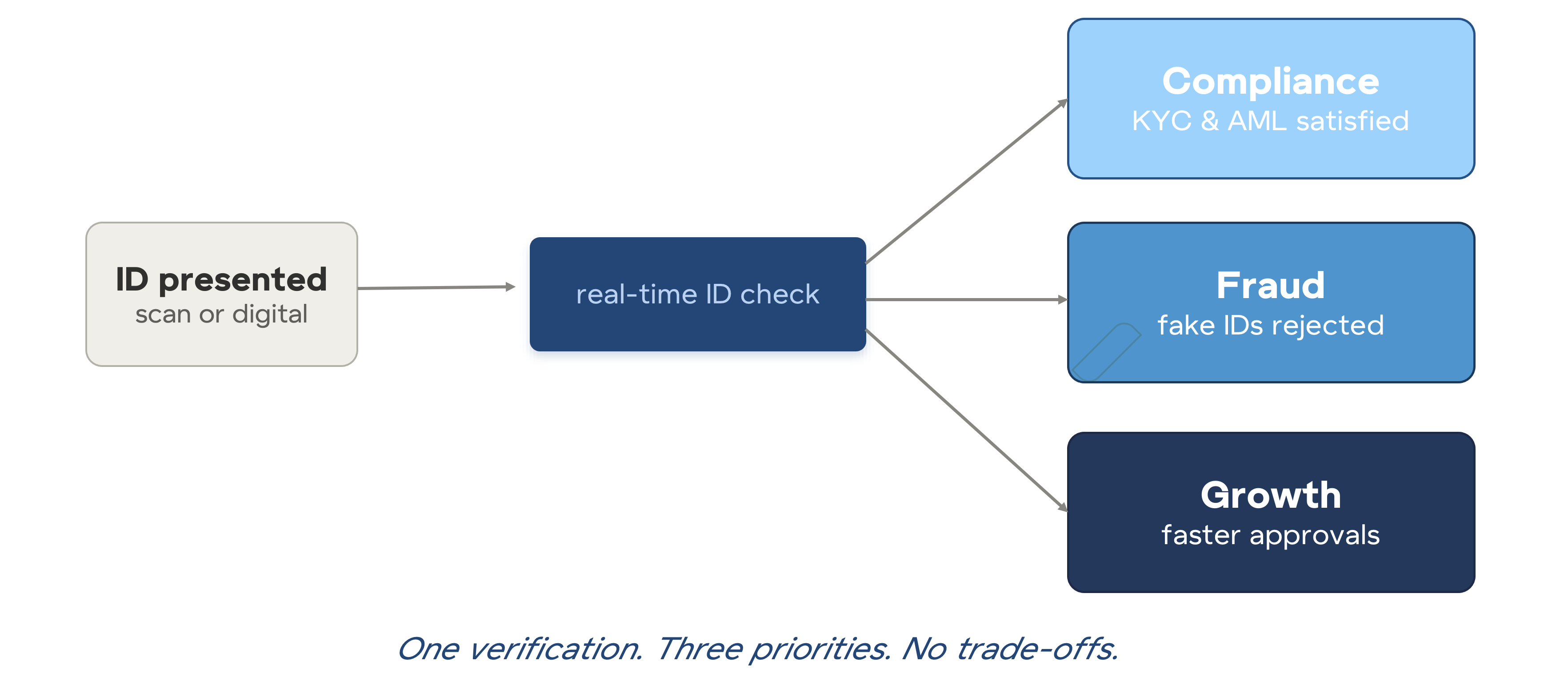
It stops being true when the verification is precise at the source. A check that determines whether an ID is genuine, doing so quickly, consistently, and with a defensible record of how it decided, satisfies all three sets of requirements with a single action.
- Compliance gets its consistent, documented standard.
- Fraud gets the fakes rejected.
- Growth gets fast approvals with few false positives, because precision is what keeps real customers from getting caught in the net.
One verification, three priorities, no trade-off. That's the bar an executive should hold any IDV decision to, and the reason all three teams should be part of the evaluation from the start.
The Intellicheck difference: reading what the fakes can't fake
This is how a solution verifies an ID stops being a technical detail and becomes the whole strategy.
Most IDV tools inspect the surface of an ID—the photo, the layout, the printed fields—using OCR and template matching. That's a visual check, and visual checks have a fatal weakness in an age of generative AI fraud: anything that can be seen can be replicated. A convincing fake will scan. It will pass OCR, match the template, and produce that reassuring green check.
meets all three priorities, without trade-offs
Intellicheck goes deeper than the surface. U.S. and Canadian IDs carry a PDF417 barcode, and within it is an embedded security structure—data formatted according to issuing-authority standards that a counterfeiter has no way to reproduce correctly because they don't have access to how it's constructed. Intellicheck analyzes that structure to distinguish a genuine, issuing-authority-produced ID from a counterfeit. It isn't reading the picture and guessing; it's verifying the part of the document that fakes can't reproduce. The result is a verification that's both highly accurate and fast enough to fit within a real onboarding flow—which is precisely why it serves compliance, fraud, and growth at once, rather than forcing a compromise among them. Additionally, the solution also serves all channels, those you plan for today and may require tomorrow: digital, in-person, and call center.
If you make one new strategic decision for your next IDV evaluation, make it this: get all three teams in the room early, and ask each vendor not whether an ID scans, but how it verifies the ID is real, maintains an audit trail, and is fast with minimal false positives. The answer to that question determines whether your three teams are compromising each other—or winning together.


.png)